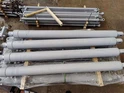

The hydraulic cylinder is composed of two parts: the main engine and the control mechanism. The main part of the hydraulic press includes the fuselage, the main cylinder, the ejector cylinder and the liquid filling device. The power mechanism consists of a fuel tank, a high-pressure pump, a low-pressure control system, an electric motor, various pressure valves and directional valves, etc. The general form of the power hydraulic cylinder is a thick-walled high-pressure vessel with one end open and one end closed. The structure of the hydraulic cylinder of the hydraulic press can generally be divided into three parts, namely the cylinder bottom, the flange and the middle thick-walled cylinder. The working cylinder of the hydraulic press has a heavy load and frequent work, and is often damaged prematurely due to improper design, manufacture or use. Therefore, for hydraulic cylinders, especially the main working cylinders of large hydraulic machines, the damage and reasons should be understood. Pay attention to the correct design, manufacture and use.
The damaged parts and characteristics of the hydraulic cylinder are that most of the damaged parts of the hydraulic cylinder are in the arc part where the flange and the cylinder wall are connected, and secondly in the arc part where the cylinder wall transitions to the bottom of the cylinder, and a few cracks are generated in the cylinder wall. Cavitation is severe and destructive. Judging from the use of hydraulic cylinders, generally they have been subjected to a high number of working loads (200,000-1.5 million times) when they are damaged. The cracks are gradually formed and expanded, which belongs to fatigue damage. Analysis of the causes of damage to hydraulic cylinders of hydraulic presses, there are many factors that affect the working life of hydraulic cylinders. It must be analyzed in light of specific circumstances, but it can be summed up in the following aspects:
(1) The cylinder wall. Generally, cracks first appear on the inner wall and gradually develop outward. The row lines develop outward, and the cracks are mostly distributed longitudinally, or at an angle of 40 degrees to the generatrix of the cylinder wall.
(2) The flange part of the cylinder. First, row lines appear on the outer surface of the cylinder flange transition arc, and gradually expand to the circumferential direction and the inner wall, or cracks expand to the nail hole, causing the flange to partially fall off. The circle cracks and falls off.
(3) Cylinder bottom, firstly, a circumferential crack begins to appear on the inner surface at the transition arc of the cylinder bottom, and gradually expands to the outer wall, and even cracks through.
(4) Cavitation, the hydraulic cylinder of the hydraulic machine is also damaged by honeycomb pitting due to cavitation, especially in the inner wall of the entry hole, which is prone to cavitation!
(5) Design reasons. Unreasonable design of structural size, such as too small flange height or too large flange outer diameter, will cause the comprehensive response to be too high and damaged.
May 17, 2023
How can the damage of the hydraulic cylinder be minimized?
Send Inquiry