


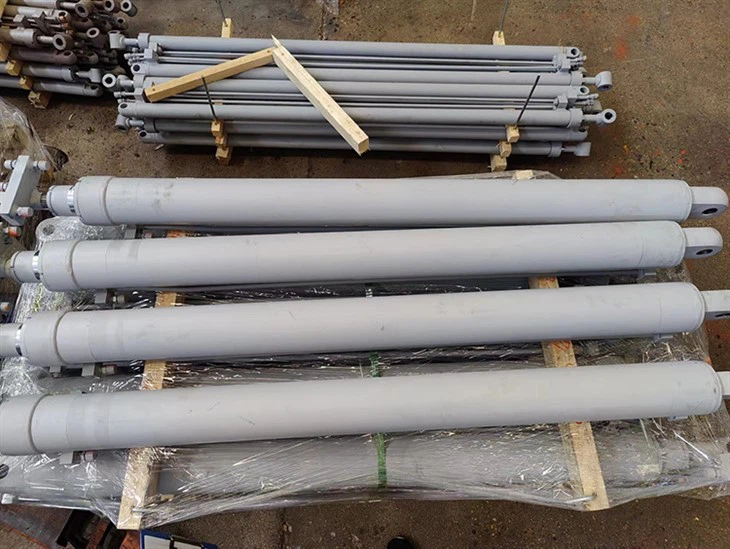


The working principle of a multi-stage hydraulic cylinder is similar to that of a single-stage cylinder. A hydraulic fluid is pumped into the cylinder, which forces the piston to move and push the rod. As the fluid enters each stage of the cylinder, the piston in that stage is activated and extends the rod further.
Multi-stage hydraulic cylinders are commonly used in applications where a long stroke is required but space is limited. Examples of such applications include dump trucks, cranes, and excavators. These cylinders can also be designed to provide different amounts of force at different stages, which allows for precise control of the speed and movement of the load being lifted or moved.
A multi-stage hydraulic cylinder is a type of hydraulic cylinder that has multiple piston stages, each of which can extend and retract independently of the other stages. The cylinder operates by using pressurized hydraulic fluid to move the pistons and extend the stages.
In general, multi-stage hydraulic cylinders are more complex than single-stage cylinders, and require more precise engineering and manufacturing. However, they can provide greater force and stroke length, making them ideal for a wide range of industrial applications, including construction equipment, mining machinery, and hydraulic presses.
Performance
Multi-stage hydraulic cylinders provide higher force output with a longer stroke length than single-stage cylinders. They are capable of generating greater power output while still maintaining a compact form factor, making them suitable for use in applications where space is limited. Multi-stage hydraulic cylinders also provide smooth and controlled movement, which is important for applications where precision is required.
Specifications
The specifications of a multi-stage hydraulic cylinder can vary depending on the specific application. The cylinder's stroke length, bore diameter, and operating pressure are some of the key specifications that need to be considered when selecting a cylinder for a particular application.
Composition
A multi-stage hydraulic cylinder typically consists of multiple piston stages that are connected to a common hydraulic fluid supply. Each piston stage has a piston rod that extends from the cylinder body, and the piston rods are connected by a common piston rod gland.
Function
Multi-stage hydraulic cylinders work by converting hydraulic energy into mechanical energy. When hydraulic fluid is pumped into the cylinder, it applies pressure to the pistons, causing them to extend and exert a force on the load being lifted or moved.
Applications
Multi-stage hydraulic cylinders are used in a variety of applications, including construction equipment, mining machinery, agricultural machinery, and hydraulic presses. They are particularly useful in applications where a high force output and longer stroke length are required within a limited space. Examples include bulldozers, excavators, cranes, and garbage trucks.
Single-stage hydraulic cylinders and multi-stage hydraulic cylinders have some key differences in terms of their performance and capabilities.
Performance
Multi-stage hydraulic cylinders provide a higher force output and longer stroke length compared to single-stage cylinders. This is because multi-stage cylinders have multiple piston stages that can extend and retract independently of each other, allowing for greater force and stroke length.
Size and Space
Multi-stage hydraulic cylinders are generally more compact than single-stage cylinders with the same stroke length and force output. This is because they can achieve a longer stroke length within a smaller space due to their design.
Control and Precision
Multi-stage hydraulic cylinders provide more precise control over the movement of the load, as each piston stage can be controlled independently. This is particularly useful in applications where precision and accuracy are critical.
Cost
Multi-stage hydraulic cylinders are generally more expensive than single-stage cylinders due to their more complex design and manufacturing process.
In summary, multi-stage hydraulic cylinders are generally preferred over single-stage cylinders when higher force output, longer stroke length, and more precise control are required, and when space is limited. However, they are also more expensive than single-stage cylinders. Single-stage cylinders are typically used in applications where a simpler design is sufficient, and where lower cost is a priority.
Hot Tags: multi stage hydraulic cylinder, China multi stage hydraulic cylinder manufacturers, suppliers, factory, Spring Return Hydraulic Cylinder, Truck Hoist Cylinder, Multi Stage Hydraulic Cylinder, Tie Rod Hydraulic Cylinder, Double Ended Hydraulic Cylinder, Single Acting Hydraulic Cylinder


